


On this page
Launching a business is a thrilling milestone, but navigating the Indian regulatory landscape can feel overwhelming. To scale your business efficiently, secure top-tier talent, and protect your personal assets, you must build on a legally compliant corporate foundation.
This comprehensive guide serves as your ultimate playbook for startup registration India success. It walks you through every strategic checkpoint—from choosing your legal entity to automated accounting and fundraising readiness—ensuring you build a compliant, investable business on Day Zero.
The Complete Founder's Blueprint
The journey to building a scale-ready enterprise in India follows a strict sequential pipeline. Skipping or delaying a single step can trigger severe financial penalties or stall future funding rounds.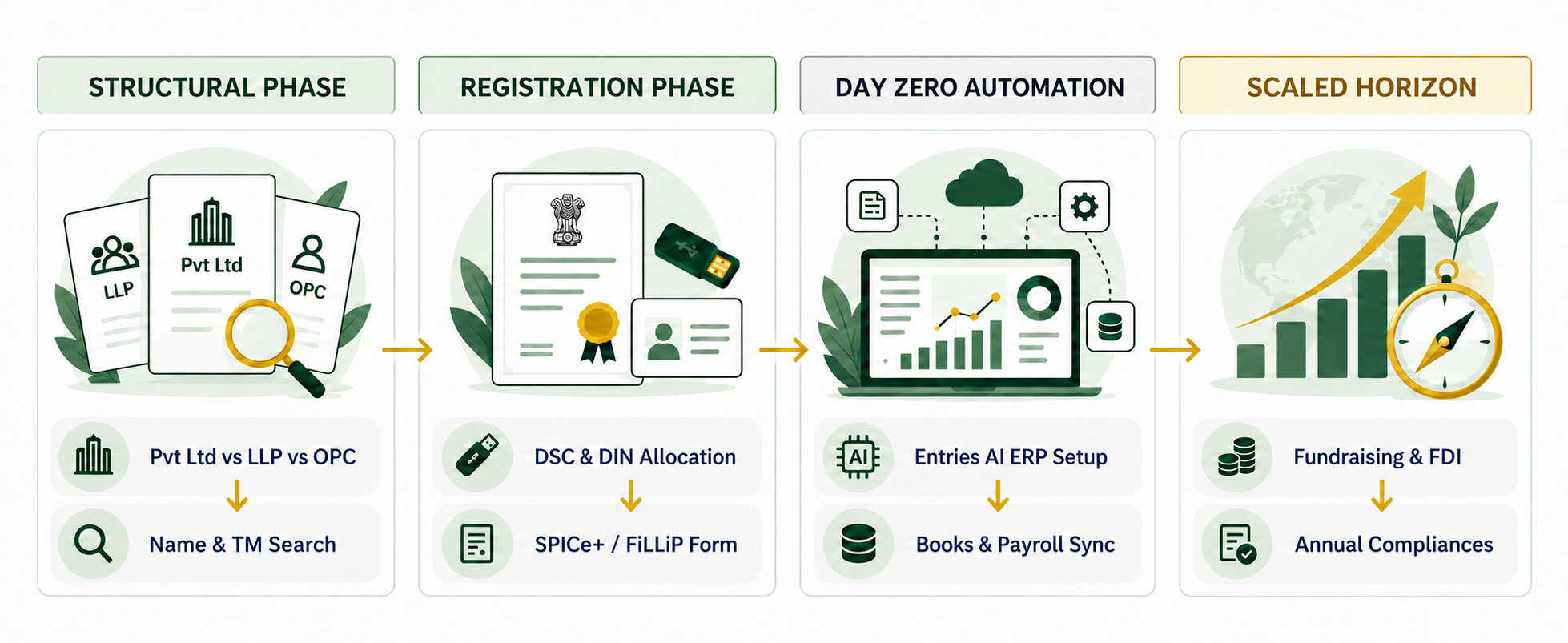
Phase 1: Pre-Incorporation Strategy (The Blueprint)
Before touching any government registration forms, your founding team must lock in your core corporate structure and intellectual property boundaries.
1. The Entity Selection: Pvt Ltd vs. LLP vs. OPC
Choosing your corporate vehicle defines your operational runway and determines your ability to raise outside capital:
- Private Limited Company (Pvt Ltd): The absolute gold standard for high-growth ventures. A Pvt Ltd registration is mandatory if you plan to raise institutional angel/VC funding, scale your operations, or issue employee stock options (ESOPs).
- Limited Liability Partnership (LLP): The lean service model. An LLP registration is ideal for professional service firms, boot-strapped consultant teams, and agencies seeking limited liability safety with lower annual compliance upkeep.
- One Person Company (OPC): Built exclusively for solo entrepreneurs who want 100% control and corporate status without needing a co-founder.
2. Clearing Name and Trademark Hurdles
Your corporate name must pass strict statutory guidelines before the Ministry of Corporate Affairs (MCA) clears your filing.
- MCA Company Name Availability Check: Your proposed name cannot be identical or phonetically similar to any existing business listed on the central registry.
- Trademark Cross-Verification: Clearing the MCA database is only half the battle. Your corporate name must not infringe on any pre-existing registered brands in the Intellectual Property India database. Launching without a thorough trademark check risks expensive, mandatory rebranding lawsuits down the line.
3. Capital, Shareholding, and Founding Agreements
- Initial Cap Table Design: Establish a clear founder equity split early. Configure your Authorized Capital (your legal share-issuing ceiling) alongside your Paid-Up Capital (the actual cash founders will deposit to fund early operations).
- Founders' Agreement: Never rely on a verbal agreement or an open spreadsheet. Before filing your incorporation documents, execute a legally binding contract that hardcodes a 4-year equity vesting schedule with a 1-year cliff. This ensures that equity is earned through long-term operational commitment, preventing co-founder disruption risks.
Phase 2: The Incorporation Mechanics (The Launch)
Once your core strategy is locked in, your business moves through the digital registration pipeline on the central MCA portal.
1. Digital Identities: DSC and DIN
Because physical paperwork is obsolete, the registration process is entirely electronic:
- Digital Signature Certificate (DSC): Every proposed director and subscriber must obtain a secure Class 3 DSC token to legally authorize online forms.
- Director Identification Number (DIN): A permanent, unique 8-digit identity number assigned to every board member. Up to three DINs are allocated free of cost directly inside the integrated incorporation application.
2. Drafting Foundational Charters
Our compliance specialists generate the constitutional documents of your firm:
- For Companies: The Memorandum of Association (MoA) outlines your core business objectives, while the Articles of Association (AoA) hardcodes your internal voting rules and governance bylaws.
- For LLPs: The LLP Agreement serves as your private operational contract, defining internal capital contributions and partner profit-sharing ratios.
3. Final MCA Filing and Identity Generation
All documents are consolidated into the integrated SPICe+ web application form (for companies) or the FiLLiP form (for LLPs) and submitted for regulatory review. Once approved, the Registrar of Companies (RoC) issues your official Certificate of Incorporation (CoI) along with your automated corporate PAN and TAN tax cards.
Phase 3: Post-Incorporation Setup (The Groundwork)
Receiving your Certificate of Incorporation means your company is legally born, but you cannot legally execute a single commercial transaction until you activate your financial setup.
1. Corporate Banking & Share Capital Injection
- Account Opening: Set up your dedicated business checking account within 30 days of receiving your CoI, using your corporate PAN, TAN, and charter documents.
- Subscription Money Remittance: Every founding shareholder listed in the MoA must physically wire their exact agreed-upon initial share capital from their personal bank account directly into the new corporate account.
2. Form INC-20A: Commencement of Business
This is the single most critical gatekeeper for a new company. You must file Form INC-20A Commencement of Business within 180 days of incorporation. This filing requires uploading explicit proof of your cleared founder subscription funds. Failing to meet this timeline results in severe financial penalties, disqualification of directors, and allows the MCA to strike off and close your business entirely.
3. Tax and Operational Linkages
Evaluate your business turnover thresholds and state mandates to secure essential operating licenses:
- GST Registration: Obtain a Goods and Services Tax status immediately if you engage in e-commerce, cross state lines, or anticipate crossing standard turnover limits.
- Local Municipal Clearances: Secure your local state-specific Shops & Establishments License, Professional Tax (PT) payroll linkages, and MSME (Udyam) certifications to streamline operations.
Phase 4: Day Zero Infrastructure with Entries AI ERP
Waiting until tax season to organize a mountain of loose receipts, messy excel sheets, and separate payroll trackers is a recipe for compliance failure. To keep your business running smoothly, founders must deploy robust accounting and data pipelines on Day Zero—the exact moment your corporate bank account goes live.
Entries AI ERP transforms complex back-office operations into an integrated, automated experience tailored specifically for fast-growing Indian companies:
- Automated Bookkeeping: Connect your corporate bank account directly to Entries AI ERP. The system tracks all your income and expenses in real time, auto-reconciles transactions, and ensures your general ledger strictly complies with Indian Accounting Standards (Ind AS).
- Unified Payroll Compliance: Say goodbye to complex spreadsheet calculations. Entries AI ERP automates your monthly employee salary generation, processes precise Tax Deducted at Source (TDS) calculations, and automatically files your state-specific Provident Fund (PF), Employee State Insurance (ESI), and Professional Tax (PT) returns.
- Real-Time Tax and Audit Readiness: Monitor your real-time tax positions via integrated dashboards. Entries AI ERP automatically tracks your monthly GST liabilities, maps your input tax credit (ITC) reconciliations, and preserves a bulletproof audit trail to ensure you are always ready for investors or tax regulators.
Phase 5: The Growth Horizon (Fundraising & FDI)
Building a scale-ready enterprise means designing your initial architecture to handle international investments and complex cap table shifts smoothly.
1. Navigating Foreign Direct Investment (FDI)
If you onboard a foreign venture capital fund, international angel investor, or an NRI onto your cap table, your startup falls under the strict governance of the Foreign Exchange Management Act (FEMA) and the Reserve Bank of India (RBI):
- The Automatic Route: Most tech, SaaS, and product companies qualify for up to 100% foreign investment without needing any prior government department permissions.
- FC-GPR Filing: Once your bank secures the international capital wire, you must formally allot the shares within 60 days. You are legally required to file the comprehensive FC-GPR return on the RBI's FIRMS portal within 30 days of share allotment, accompanied by a certified Fair Market Value (FMV) report from a practicing CA or SEBI-registered Merchant Banker.
- Annual FLA Return: If your balance sheet continues to hold international investment blocks, you must submit an annual Foreign Liabilities and Assets (FLA) return to the RBI by July 15th every year to ensure macro-economic financial transparency.
2. Maintaining Flawless Ongoing Corporate Governance
To keep your limited liability shield intact and remain fully investable, your startup must execute a series of mandatory, time-bound legal duties every financial year:
- Conducting your company's first official Board Meeting within 30 days of launch, and at least four board sessions every calendar year.
- Filing your comprehensive annual audited financial statements with the MCA via Form AOC-4 within 30 days of your Annual General Meeting (AGM).
- Submitting your updated shareholder roster, cap table transformations, and director logs via Form MGT-7 within 60 days of your AGM.
Launch and Automate Your Business with Entries Ignite
Chasing separate lawyers, tracking complex state stamp duties, manually calculating payroll withholding metrics, and dealing with unpredictable government filing portal delays can easily drain a founding team's execution momentum. Entries Ignite eliminates the traditional friction from your entire company incorporation India and startup compliance India journey.
Our unified corporate operating platform acts as your enterprise-grade digital secretarial suite and launch engine. Securely model your cap table splits, archive your founder credentials inside an encrypted compliance vault, collaborate directly with certified tax and secretarial experts, and deploy Entries AI ERP on Day Zero to automate your bookkeeping, tax, and payroll pipelines inside one streamlined digital workspace.
Start the entire incorporation checklist through Entries Ignite and track documents, tasks, and registrations in one place!


