
On this page
Many brilliant founders choose a Limited Liability Partnership (LLP) when launching their business. It is a smart, lean move for the early stages—offering personal asset protection, minimal regulatory overhead, and low annual compliance costs.
However, once your product hits the market, scales, and attracts the attention of venture capitalists or angel networks, your lean corporate structure will face an institutional wall. The moment a fund hands you a term sheet, their first condition precedent (CP) will almost universally be: Convert your LLP into a Private Limited Company.
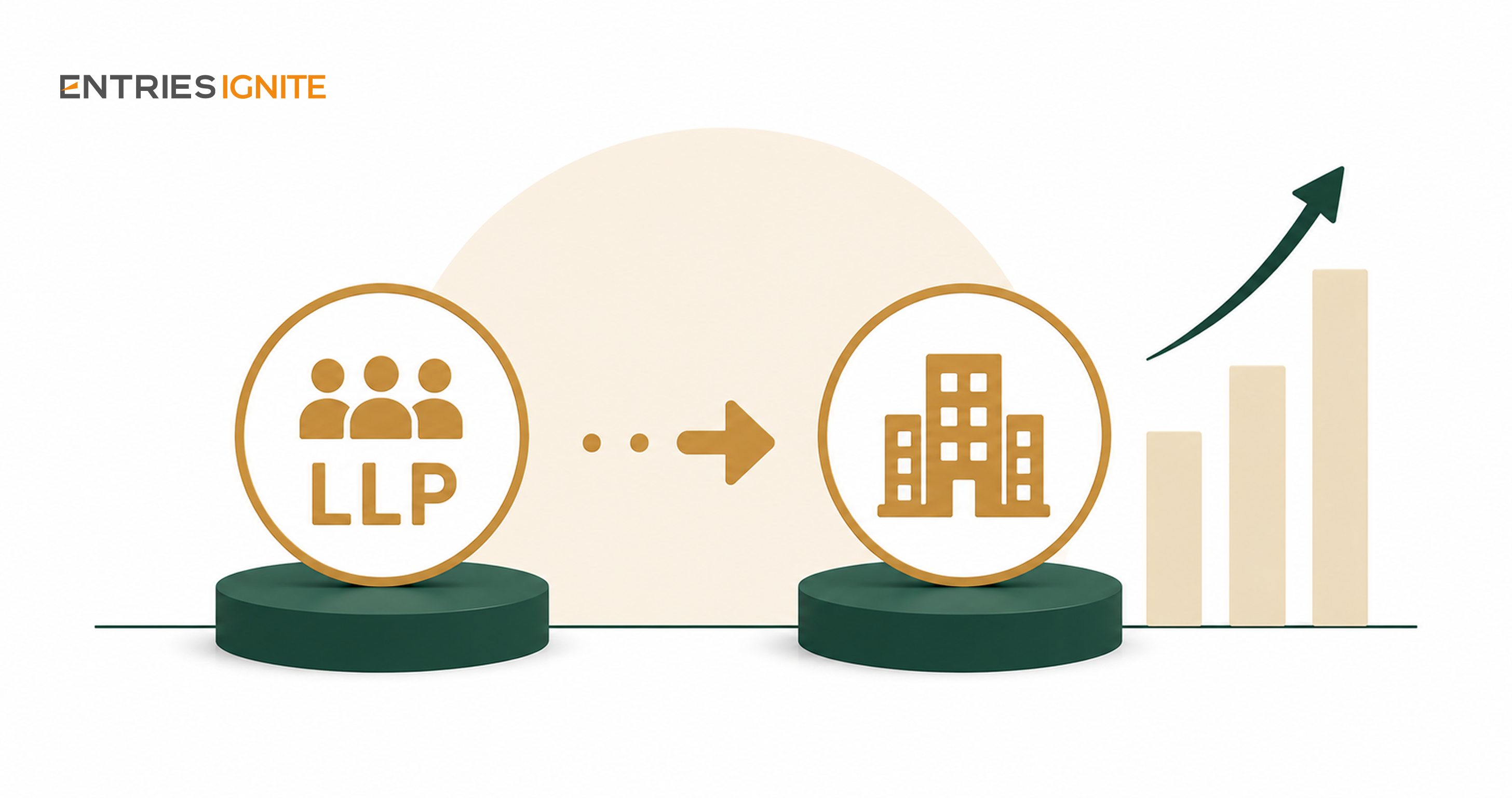
Making the transition from an agreement-driven partnership to a share-based company is a common milestone in the LLP to private limited company pipeline. This guide explains why institutional investors demand this structural shift, how the conversion works, and the critical tax, asset, and IP migration rules your founding team must consider.
Why Investors Avoid LLPs and Demand a Pvt Ltd Structure
To navigate startup LLP funding conversations successfully, you must understand why venture capitalists aggressively push back against the partnership model:
1. Fluid Equity Issuance vs. Rigid Partnership Stakes
A Private Limited company is built entirely around fractionally divisible shares. Investors can buy newly minted equity at a specific share premium, cleanly separating company valuation from founder cash injections. In contrast, an LLP is driven by fixed partner contribution balances. Onboarding a VC into an LLP requires making the institutional fund an active partner with direct legal liabilities, which corporate investment funds are structurally barred from doing.
2. The ESOP Employee Incentive Engine
Venture-backed startups scale by hiring premium tech and growth talent. VCs will expect you to create a 10% to 15% equity incentive pool. Because an LLP has no shares, it cannot support a traditional Employee Stock Option Plan (ESOP). A Pvt Ltd structure provides the necessary legal framework under the Companies Act to pool, vest, and distribute options to your team.
3. Standardized Corporate Governance and Cap Tables
An LLP’s internal mechanics are highly private and written into a custom LLP Agreement, creating unpredictable governance baselines for external investors. A Private Limited company operates under a highly standardized, predictable regulatory framework (the Companies Act + Articles of Association). This structure gives investors transparent protection via clear board seats, investor director veto rights, and structured startup cap table dilution rules.
Key Conversion & Structural Restructuring Considerations
To convert LLP to Pvt Ltd status safely, your corporate legal desk must manage the transition across three complex operational pillars:
1. Legal Conversion Mechanics (Chapter XXI of the Companies Act)
The cleanest way to transition is through the formal "Conversion by Succession" route under the Companies Act.
- The Prerequisites: To qualify for an automatic statutory conversion, your LLP must have a minimum of two partners, its annual financial filings (Form 8 and Form 11) must be completely up to date with the MCA, and you must secure written, unanimous consent from every active partner and secured creditor.
- The Execution: You will file the comprehensive Form URC-1 along with the standard integrated SPICe+ incorporation forms to mirror your existing partnership into a fresh corporate structure.
2. Tax and Stamp-Duty Risks
A poorly structured corporate restructuring can accidentally trigger major capital gains tax liabilities for the founders.
- Income Tax Exemptions (Section 47(xiii) of the IT Act): The transfer of your business from an LLP to a company is entirely exempt from capital gains tax, provided you meet strict conditions:
- All partners of the LLP must become shareholders of the new company in the exact same proportion as their original capital splits.
- The founders must not receive any form of consideration or payment other than newly issued corporate shares.
- The original founders must collectively maintain at least 51% of the total voting power in the new company for a minimum period of five years from the date of conversion.
- State-Specific Stamp Duty: While your corporate identity transitions, migrating your real estate leases or office titles will attract state-level stamp duty surcharges. Check your local regional guidelines to budget for these state-specific transfer costs.
3. Contracts, Assets, and IP Migration
Your startup's true economic value resides in its proprietary code, brand equity, customer contracts, and physical assets. You must migrate these assets seamlessly to the new entity:
- Intellectual Property (IP) Re-Assignment: Any code, trademark, or domain name originally registered under the LLP's name or a founder's personal name must be formally assigned to the new Private Limited company via a legally binding IP Assignment Agreement to guarantee clean ownership ahead of investor due diligence.
- Vendor and Customer Novation: Your active client contracts, SaaS subscriptions, payment gateway integrations, and employee employment letters do not automatically shift to the new company. You must execute formal Novation Agreements to legally transfer these obligations from the old LLP to the new Pvt Ltd entity.
Bridge Your Corporate Transition with Entries Ignite
Managing complex asset migrations, formatting your initial shareholder cap tables to match VC expectations, and navigating the nuances of MCA Chapter XXI filings can pull founders away from product engineering and sales growth. Entries Ignite turns high-stakes corporate restructuring into a smooth, clear digital experience.
Our unified corporate operations platform acts as your enterprise-grade transition cockpit. Securely upload your historical partnership records into an encrypted vault, track your conversion milestones via real-time timeline charts, collaborate directly with seasoned FEMA and corporate compliance specialists, and prepare your startup flawlessly for institutional venture capital investment.
Start the entire incorporation checklist through Entries Ignite and track documents, tasks, and registrations in one place!

Nagendra Raju
Co-founder of Entries.AI, leading the charge in building a unified business application that simplifies how SMBs operate today. Instead of juggling multiple-point solutions, SMBs can now rely on a single, seamless system that connects their entire workforce, operations, accounting, and finance functions.


