
On this page
If you are a solo entrepreneur, consultant, or independent software developer ready to formalize your business, you face a critical structural crossroad. Choosing your legal framework is the most vital foundational step you will take. It dictates your personal asset liability, your monthly compliance costs, and how easily you can scale your operations.
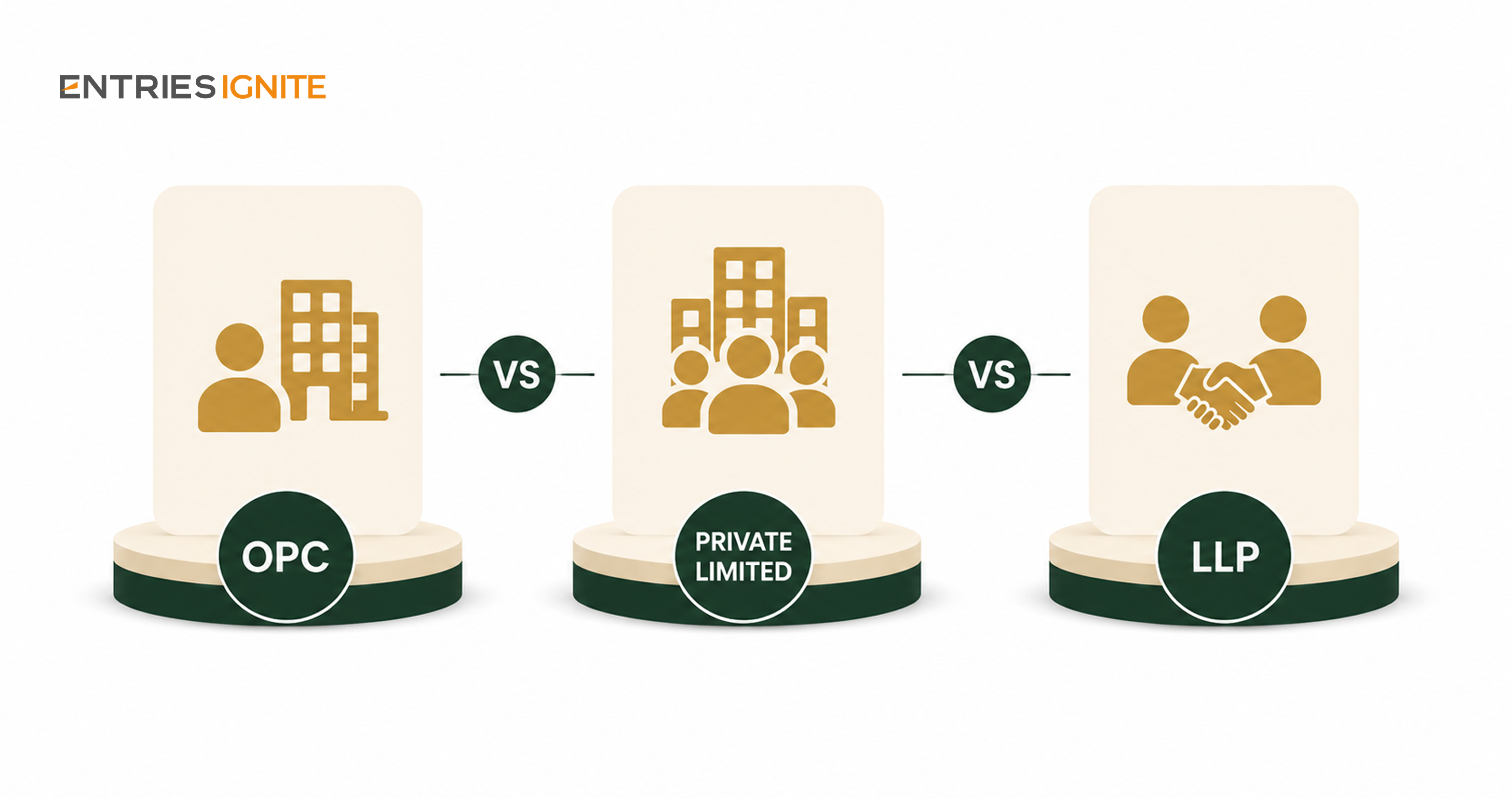
In India, the three most reliable corporate vehicles are a One Person Company (OPC), a Private Limited Company (Pvt Ltd), and a Limited Liability Partnership (LLP). While all three protect your personal wealth from corporate debts, they serve completely different growth trajectories. This comprehensive guide breaks down the core differences in the OPC vs Pvt Ltd and OPC vs LLP debate so you can choose the best entity for startup or solo success.
Side-by-Side Comparison: OPC vs Pvt Ltd vs LLP
Understanding how these structures stack up on core features helps clear away the noise and highlights your ideal fit:
|
Feature / Metric |
One Person Company (OPC) |
Private Limited (Pvt Ltd) |
Limited Liability Partnership (LLP) |
|
Minimum Shareholders |
Exactly 1 (Must be an Indian resident natural person) |
Minimum 2 (Maximum 200) |
Minimum 2 Partners (No upper limit) |
|
Minimum Directors |
Minimum 1 |
Minimum 2 |
Minimum 2 Designated Partners |
|
Nominee Requirement |
Mandatory (To take over in case of death/incapacity) |
Not Applicable |
Not Applicable |
|
External Funding / VCs |
Extremely difficult (Cannot split or sell equity easily) |
The Gold Standard (Preferred by Angels and VCs) |
Less suitable for conventional VC equity rounds |
|
ESOP Employee Pools |
Not Available |
Fully Supported |
Conventional ESOP structures unavailable |
|
Compliance Overhead |
Moderate (Lower than Pvt Ltd; exemptions apply) |
Highest (Strict annual audits and filings) |
Lowest (Audit exemptions below specific thresholds) |
|
Best Suited For |
Solo founders, consultants, single artisans |
High-growth startups aiming to raise capital |
Professional service firms, agencies, bootstrapped teams |
1. The One Person Company (OPC): The Solo Entrepreneur's Shield
Introduced to support solo business owners, an OPC allows a single individual to enjoy the prestige and safety of a corporate entity without needing a co-founder.
The Advantages:
- Absolute Single Ownership: You own 100% of the equity shares and maintain absolute executive control over every business choice.
- Limited Liability Protection: Your personal home, bank accounts, and investments are legally separated from the liabilities of your commercial business.
- Exemption from Certain Compliances: An OPC does not need to hold an Annual General Meeting (AGM) or record complex quarterly board minutes if it has only one director.
The Disadvantages:
- Mandatory Nominee Clause: You must legally name a nominee person during incorporation. If you pass away or face medical incapacity, that nominee automatically takes charge of your shares, which can complicate family estate transitions.
- Zero Venture Capital Scalability: VCs cannot buy equity inside an OPC because it is legally restricted to a single shareholder. If you take outside capital, you are legally forced to convert the OPC into a standard Pvt Ltd company first.
2. The Private Limited Company (Pvt Ltd): The Scalable Tech Engine
A Private Limited entity is built for rapid, multi-founder scale and is the undisputed vehicle for venture-backed businesses.
The Advantages:
- VC and Angel-Friendly Infrastructure: It provides a clean, globally recognized mechanism to issue equity shares, assign corporate valuations, and onboard global investors.
- Employee Stock Options (ESOPs): You can easily set aside a 10% to 15% equity pool to attract top-tier tech or marketing talent without burning your cash runway.
- Credibility and Global Trade: Enterprise B2B clients, overseas buyers, and premium payment gateways treat Pvt Ltd structures with the highest level of institutional trust.
The Disadvantages:
- Needs a Minimum of Two People: You cannot register a Pvt Ltd company alone. You must find at least one co-founder or assign a nominal share to a family member to meet the legal two-shareholder minimum.
- Heavy Compliance Burdens: Requires mandatory annual statutory audits, regular board sessions, and strict MCA filings (AOC-4 and MGT-7) from Year 1, regardless of your revenue.
3. The Limited Liability Partnership (LLP): The Lean Service Model
An LLP combines the limited liability safety of a company with the simple internal flexibility of a traditional partnership firm.
The Advantages:
- Lowest Running Costs: LLPs have minimal regulatory overhead. Mandatory tax and accounting audits only kick in if your annual turnover crosses ₹40 Lakhs or your capital contribution exceeds ₹25 Lakhs.
- No Rigid Share Rules: Your internal profit-sharing ratios, voting weights, and management rules are custom-written into your private LLP Agreement, completely decoupled from initial capital contributions.
- No Dividend Distribution Tax (DDT) Hurdles: Moving profits from the business entity directly into the partners' personal pockets is generally more tax-efficient than extracting corporate dividends.
The Disadvantages:
- Requires at Least Two Partners: Like a Pvt Ltd company, you cannot run an LLP as a solo founder; you require a minimum of two active partners.
- No Institutional Venture Capital: Institutional funds aggressively avoid LLPs because they cannot carve out fractional equity shares without becoming active, legally liable partners in the firm.
The Verdict: Selecting Your Ultimate Corporate Path
To lock in your ideal company structure India strategy, match your current business reality to these three operational endpoints:
- Choose an OPC if: You are an independent solo consultant, freelancer, software engineer, or single creator who wants a separate corporate identity, intends to stay solo, and has no plans to pitch to venture capitalists or issue employee stock options.
- Choose a Pvt Ltd Company if: You are building a scalable tech, product, or e-commerce startup, have at least one co-founder, and intend to pitch to angel investors or VC funds to raise capital within your first 12 to 24 months.
- Choose an LLP if: You are launching a professional service agency, consultancy partnership, boot-strapped team, or localized brick-and-mortar business where multiple partners share operations and you want low annual compliance upkeep.
Standardize Your Business Launch with Entries Ignite
Navigating complex MCA portal definitions, drafting custom corporate charters, and setting up initial director credentials shouldn't pull you away from building your core product or serving your clients. Entries Ignite takes the friction out of business onboarding.
Our unified corporate operations suite acts as your digital secretary. Securely upload your founder KYC details into an encrypted compliance vault, map out your initial equity splits or partnership terms, collaborate directly with startup compliance specialists, and launch your entity cleanly inside one streamlined digital workspace.
Start the entire incorporation checklist through Entries Ignite and track documents, tasks, and registrations in one place!

Nagendra Raju
Co-founder of Entries.AI, leading the charge in building a unified business application that simplifies how SMBs operate today. Instead of juggling multiple-point solutions, SMBs can now rely on a single, seamless system that connects their entire workforce, operations, accounting, and finance functions.


