


On this page
Expanding your business operations into India is one of the most strategic growth moves a global corporation can make. To capture this market efficiently while maintaining full corporate control, foreign parent companies typically choose to set up a wholly owned subsidiary India layout.
Operating as an independent legal entity, an Indian subsidiary shields the parent corporation from localized liabilities while unlocking access to domestic tax incentives, government tenders, and a highly skilled workforce. This guide breaks down the structural design, registration paperwork, and compliance frameworks required for a successful corporate launch.
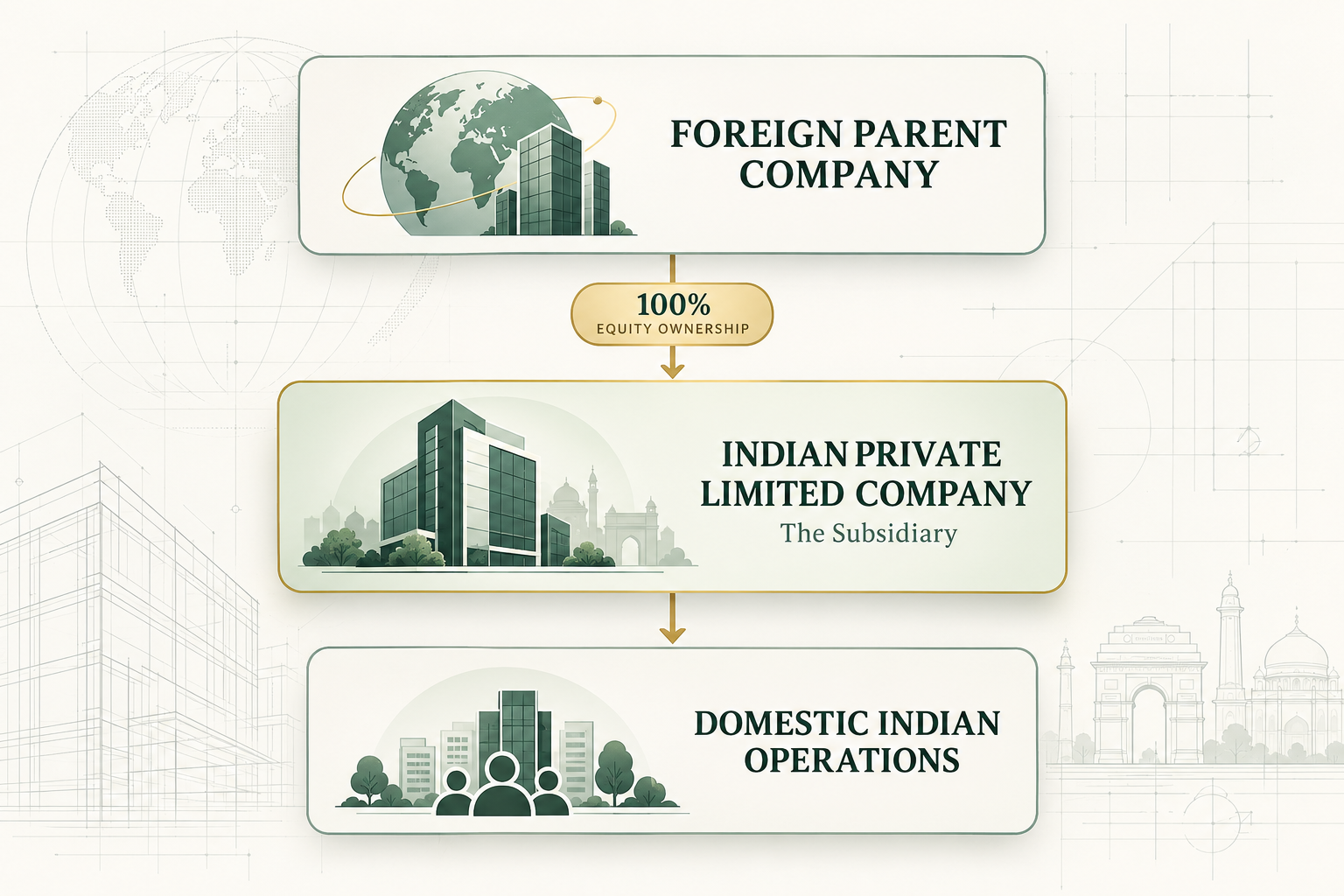
The Corporate Structure of an Indian Subsidiary
The blueprint for setup is highly standardized. It operates via an independent corporate vehicle:
Key Structural Requirements and Compliance Steps
To smoothly execute a foreign company incorporation India strategy, your corporate development team must satisfy several foundational and ongoing mandates:
1. Board Composition and Shareholding
-
Foreign Parent as Shareholder: For a 100% foreign owned company India layout, the foreign parent corporation holds 99.99% of the shares. Under Indian law, a Private Limited Company requires at least two shareholders, so one share is typically assigned to a nominee individual holding it on behalf of the parent firm.
-
Indian Resident-Director Requirement: At least one member of your board of directors must be an Indian resident (present in the country for at least 182 days in the previous financial year).
-
Foreign Directors: The remaining board seats can be held by foreign nationals or NRIs. They must obtain an Indian Director Identification Number (DIN) and a digital signature.
2. Foreign Corporate Subscriber Documentation
Because a corporate entity—rather than an individual—is subscribing to the shares, the Registrar of Companies (RoC) requires extensive, verified documentation from the parent company:
- Certificate of Incorporation or charter of the foreign parent company.
- Board Resolution from the parent firm authorizing the setup of the Indian entity, approving the capital allocation, and naming an Authorized Representative.
- KYC of the Authorized Representative: Apostilled passport and international address proofs for the individual designated to sign the Indian incorporation forms.
- Document Legalization: All documents executed outside India must be officially notarized and Apostilled (if your home country belongs to the Hague Convention) or validated via Consular Authentication at the nearest Indian Embassy.
3. Finalizing the MOA and AOA
The Memorandum of Association (MOA) and Articles of Association (AOA) serve as your subsidiary's legal constitution. For a foreign subsidiary, the core objects clause of the MOA must explicitly state that it is authorized to carry out the specific business activities dictated by the parent company. These documents must be signed by the Authorized Representative before a public notary or consular officer.
4. Capital Subscription and Banking
- Corporate Bank Account: Once the Certificate of Incorporation is granted, the subsidiary must immediately open a dedicated domestic corporate bank account.
- Capital Remittance: The foreign parent company must wire the agreed-upon capital subscription amount directly from its foreign bank account into the new Indian corporate account within 180 days.
5. FDI, FEMA, and RBI Considerations
Foreign direct investment (FDI) in India is strictly governed by the Foreign Exchange Management Act (FEMA).
- Automatic Route vs. Approval Route: Most industrial sectors allow 100% FDI via the Automatic Route, meaning no prior government approvals are needed. Specialized sectors (like defense or banking) require explicit department clearances.
- RBI Reporting: Within 30 days of receiving the capital investment, the Indian subsidiary must submit a Foreign Liabilities and Assets (FLA) return and report the share issuance to the Reserve Bank of India (RBI) via the single master form (SMF) on the FIRMS portal.
6. Beneficial Ownership Considerations
Under India's Significant Beneficial Owner (SBO) rules, companies must declare the ultimate natural persons who exercise significant control or hold more than 10% of indirect shareholding or voting rights in the Indian entity through the foreign parent chain. This prevents illicit corporate masking and ensures absolute transparency.
7. Ongoing Company-Law Compliance
An Indian subsidiary registration means the business must be treated exactly like a domestic company. Your team must handle ongoing compliance duties:
- Conducting regular Board Meetings and an Annual General Meeting (AGM).
- Maintaining statutory registers and bookkeeping under Indian Accounting Standards (Ind AS).
- Filing annual financial audits and tax returns with the RoC and the Income Tax Department.
Centralize Your Global Expansion with Entries Ignite
Coordinating with overseas corporate secretaries, obtaining apostille seals across different international time zones, and navigating the nuances of RBI reporting can severely delay your market entry. Entries Ignite removes the friction from cross-border expansions.
Our enterprise-grade platform serves as a unified command center. Safely upload localized parent company credentials into our encrypted document vault, track your foreign company subsidiary India milestones in real-time, and collaborate directly with cross-border compliance specialists to ensure total corporate alignment from day one.
Start the entire incorporation checklist through Entries Ignite and track documents, tasks, and registrations in one place!


