

On this page
Attracting top-tier engineering, product, and growth talent is one of the biggest hurdles an early-stage startup faces. When your cash runway is tight and you cannot match corporate tech salaries, equity becomes your greatest recruiting weapon. This is where an Employee Stock Option Plan (ESOP) comes into play.
When registering a Private Limited company, many first-time founders wonder whether they need to bake this option pool directly into their starting paperwork. Should you carve out employee shares on Day 1, or wait until an institutional investor writes a check? This guide breaks down the mechanics of an ESOP pool startup strategy and how it impacts your cap table, authorized capital, and investor negotiations in India.
What is an ESOP and Why Do Startups Need One?
An ESOP is a corporate framework that grants employees the right to purchase a specific number of company shares at a pre-determined, discounted price after a certain period (known as the vesting period).
Startups create a dedicated employee stock options private limited company pool for three primary reasons:
- Conserving Early Cash: It allows you to hire premium executive talent below market cash rates by compensating them with long-term upside.
- Aligning Incentives: It transforms early employees into stakeholders, ensuring their daily output directly matches the company's valuation growth.
- Retaining Top Talent: Because options vest incrementally over time (typically a 4-year schedule with a 1-year cliff), it serves as a powerful retention tool.
Does the ESOP Pool Need to Exist on Day 1?
The short answer is no—you should not create a formal ESOP pool on the exact day of incorporation.
While having an equity-incentive mindset is vital, setting up an official option pool during your initial MCA filing is an administrative mistake. Here is why:
1. Authorized Capital and Upfront Government Fees
To create an ESOP pool on Day 1, you would have to expand your initial authorized capital startup baseline significantly to accommodate both the founders' shares and the unallocated employee shares. The MCA charges non-refundable stamp duties and registration fees based on this upper authorized limit. Raising this ceiling before you even hire your first engineer means paying unnecessary upfront government fees out of your early runway.
2. The Legal Sequence of Share Issuance
Under the Indian Companies Act, an ESOP pool cannot simply exist in a vacuum as "unallocated shares." Setting up a scheme requires passing a special resolution, forming a nomination and remuneration committee, and explicitly drafting an ESOP scheme document. Rushing this complex legal process during incorporation—before your business model or hiring roadmap is validated—creates unnecessary administrative overhead.
The Investor Expectation: Before vs. After Funding
The real catalyst for establishing a formal startup ESOP India pool is your first institutional funding round. This is where strategic cap table positioning becomes critical.
Institutional venture capitalists (VCs) will almost universally mandate the creation of a 10% to 15% ESOP pool as a condition precedent (CP) before they wire seed or Series A capital. However, when and how this pool is created drastically changes who bears the cost of dilution: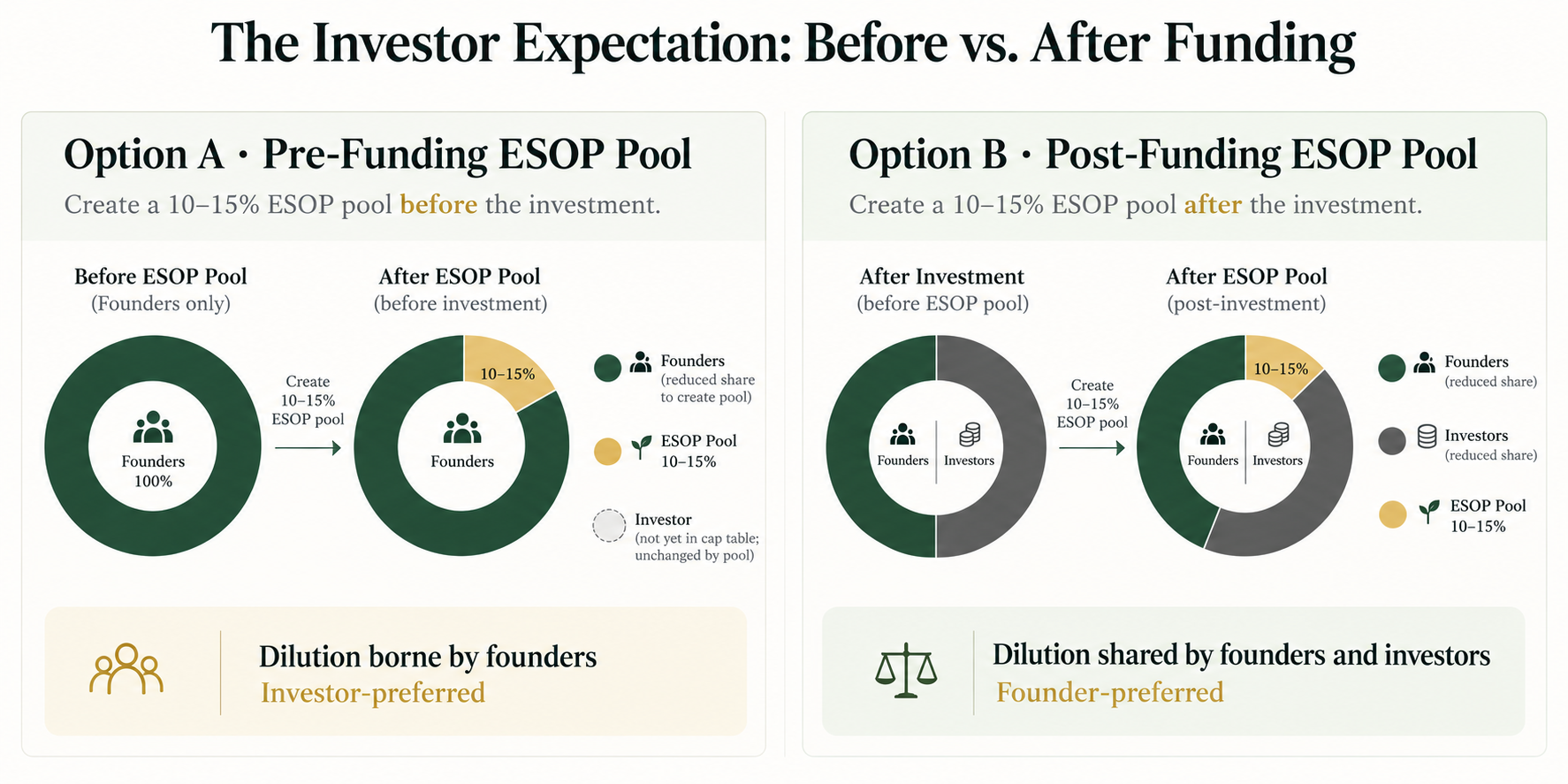
The Dilution Math Trap
Investors will structurally insist that the ESOP pool be created immediately before the funding round closes (Pre-Money). This means the 10% or 15% equity block is carved entirely out of the founders' shares, protecting the incoming investor from immediate dilution.
- Example: If you and your co-founder own 100% of a company on Day 1, and an investor demands a 10% ESOP pool inside the pre-money cap table, your founding stake instantly drops to 90% before the investor's cash even hits the account. If you attempt to negotiate a Post-Money ESOP pool creation, both you and the incoming investor dilute proportionally, which institutional funds will aggressively push back against unless your valuation is exceptionally high.
Authorized Capital Considerations for Founders
Even though you should not formally launch the ESOP scheme on Day 1, you must think ahead when structuring your initial share capital splits:
- Keep Your Early Capital Lean: Incorporate with a modest authorized capital baseline (such as ₹1,00,000 to ₹5,00,000) that perfectly covers your active founding equity splits.
- Expand During the Term Sheet Phase: When a seed fund or angel network issues a term sheet, use a portion of that incoming capital to pay the MCA fees required to expand your authorized share capital. This allows you to simultaneously create the new share classes needed for the investor and open up the fresh equity block required for the employee option pool.
Modele Your Cap Table Perfectly with Entries Ignite
Miscalculating early dilution metrics, overpaying on initial authorized capital fees, or drafting flawed equity-sharing clauses can lead to messy restructuring disputes later. Entries Ignite simplifies your startup's equity and legal onboarding journey.
Our unified corporate operations platform acts as your digital secretary and cap table modeler. Seamlessly map out your founding shares, project your future investor dilution scenarios, securely store your corporate documents in an encrypted vault, and collaborate directly with startup compliance experts to structure your venture cleanly for future scale.
Start the entire incorporation checklist through Entries Ignite and track documents, tasks, and registrations in one place!