


On this page
When launching a new venture, timing is everything. One of the most frequent questions founders ask is: "How many days does company registration take in India?"
The short answer is that the core government approval process typically takes between 7 to 12 working days. However, treating incorporation as a single, instantaneous event is a mistake. Company formation is a multi-stage operational journey.
Your actual Pvt Ltd incorporation timeline depends heavily on your document readiness, the uniqueness of your proposed name, Ministry of Corporate Affairs (MCA) processing queues, and whether a government officer flags your application for a resubmission or clarification [0.6, 0.7]. This guide breaks down the end-to-end journey from raw information to a fully operational, compliant corporate entity.
The Corporate Journey: From Idea to Open for Business
To manage your launch expectations, visualize your company registration time India path across nine distinct procedural steps: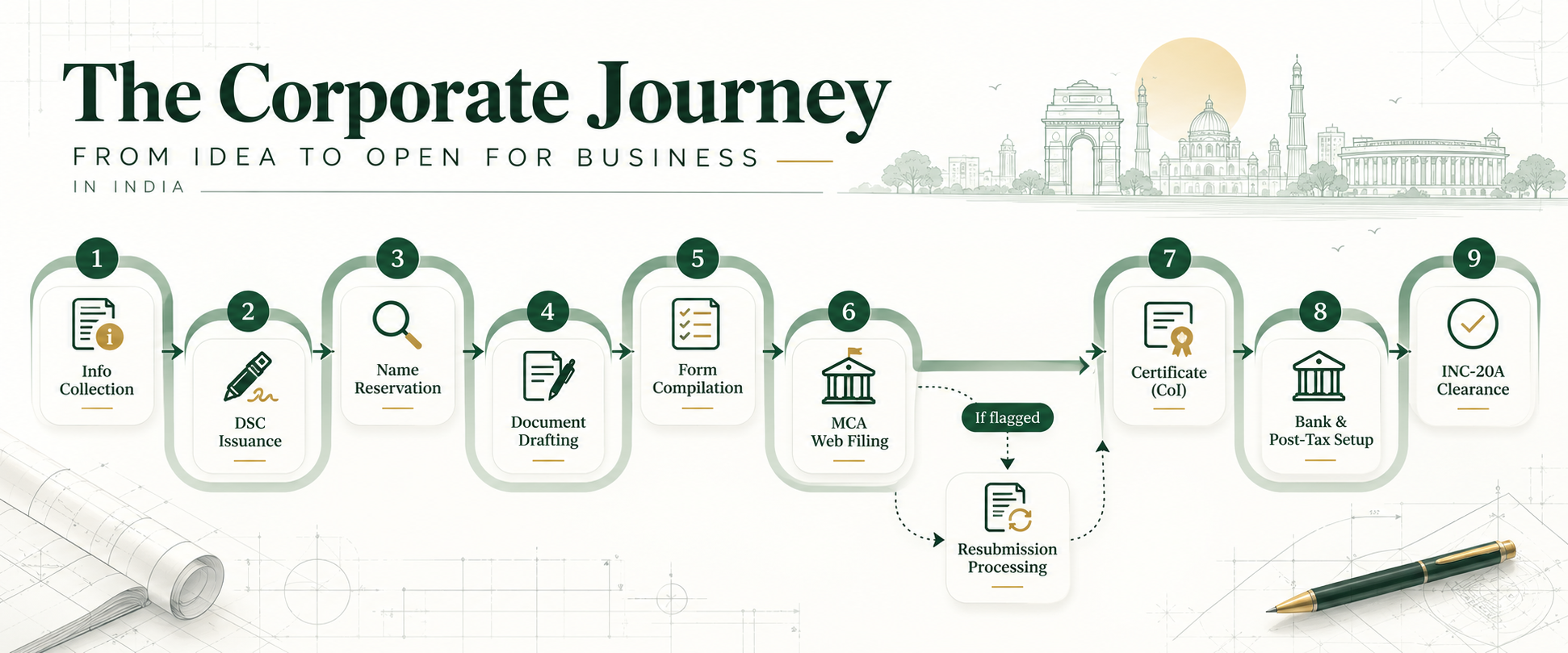
Deconstructing the Pvt Ltd Incorporation Timeline
Step 1: Information and KYC Collection (Day 1)
The clock starts the moment your team aligns on the core corporate blueprint. You must gather mandatory identity assets (PAN, Aadhaar/Passport) and recent address proofs (utility bills under 2 months old) for all initial directors and shareholders.
- Timeline Anchor: Delays here are entirely driven by document readiness. If a founder submits a blurred bill or mismatched name spelling, it stalls the pipeline on Day 1.
Step 2: Digital Signature Certificate (DSC) Issuance (Day 2)
Because physical paperwork is obsolete, every proposed director and subscriber must obtain an Indian Class 3 DSC to electronically sign the digital MCA forms.
- Timeline Anchor: Once identity documents and video-verification steps are completed by the founders, certified authorities usually issue the digital tokens within 24 hours.
Step 3: Name Search and Reservation (Days 3–4)
Your company name must pass strict statutory guidelines. It cannot look, sound, or spell similar to any existing business or registered trademark. You can reserve it beforehand using the RUN (Reserve Unique Name) web service or file it directly inside the integrated SPICe+ form.
- Timeline Anchor: Clear name availability is vital. If you pick a unique name, approval takes 1–2 days. If your name choice triggers a trademark conflict, the MCA will reject it, forcing you to restart the naming process from scratch.
Step 4: Legal Document Drafting (Day 5)
Our compliance specialists draft your company's foundational corporate charters: the Memorandum of Association (MOA) and Articles of Association (AOA). These documents define your corporate objects, internal governance rules, and initial shareholding splits.
Step 5: Integrated MCA Portal Filing (Days 6–7)
All drafted charters, director declarations, office address proofs, and identity logs are consolidated into the comprehensive digital SPICe+ web application and submitted to the MCA portal along with state-specific stamp duty fees.
Step 6: MCA Processing & Resubmission Risk (Days 8–10)
A Central Scrutiny Cell officer reviews your digital file. If your application is perfect, they grant approval.
- The Resubmission Trap: If the officer spots a minor clerical error, a hazy utility bill, or requires a deeper explanation regarding your business classification, they will mark the application for Resubmission (BRER). You are granted 15 days to rectify and refile the form, which can add 2 to 4 working days to your total timeline.
Step 7: Generation of the Certificate of Incorporation (Day 11)
Once the files clear scrutiny, the Registrar of Companies (RoC) issues your official Certificate of Incorporation (CoI). This digital certificate contains your unique Corporate Identification Number (CIN) alongside your newly generated company PAN and TAN tax identities. At this precise moment, your legal corporate entity is officially born.
Step 8: Corporate Bank Account and Post-Tax Setup (Days 12–15)
With your CoI and tax cards active, you can open your dedicated corporate bank account. All founding shareholders must immediately wire their exact agreed-upon initial share capital from their personal accounts into this new corporate account. You will also use this window to evaluate and secure optional tax linkages like GST registration.
Step 9: Commencement of Business Compliance (Day 16+)
Before you can legally sign client contracts, hire permanent staff, or accept external investments, a director must file Form INC-20A Commencement of Business with the MCA [12.1]. This filing requires uploading clear bank statements showing the successfully cleared founder subscription money [12.1].
Accelerate Your Startup Launch with Entries Ignite
Chasing physical document token vendors, managing spelling variations across regional ID cards, and tracking unpredictable MCA portal approval cycles can easily stall your business launch. Entries Ignite turns a fragmented legal journey into an automated, transparent experience.
Our unified corporate operating platform serves as your digital secretary. Securely upload your founder credentials into an encrypted compliance vault, watch your registration progress move across real-time milestone trackers, collaborate directly with corporate secretarial specialists, and minimize your how many days company registration timeline from your desktop or phone.
Start the entire incorporation checklist through Entries Ignite and track documents, tasks, and registrations in one place!


