
On this page
Naming your startup is one of the most exciting parts of the entrepreneurial journey. However, turning that brainstormed name into a legally recognized corporate entity in India requires clearing two entirely different government hurdles.
First, your name must pass the strict statutory guidelines of the Ministry of Corporate Affairs (MCA). Second, it must not violate existing intellectual property laws.
A major trap for new founders is assuming that securing an official corporate name means they automatically own the rights to the brand. In reality, it does not. This comprehensive guide breaks down how the MCA company name availability process works, how to navigate the SPICe+ company name pipeline, and why a corporate name approval is completely useless without a matching trademark.
Part 1: How to Pass the MCA Name Approval Process
The MCA rejects thousands of proposed names every month. The government isn't checking if your name sounds trendy—it is checking for absolute statutory compliance. When you execute a company name search India check, your name must clear several strict legal filters.
1. Avoid Existing Corporate and LLP Names
Your proposed name cannot be identical or deceptively similar to any existing business already registered on the MCA database. If a company named "Pixel Tech Private Limited" exists, you cannot register "Pixel Tech India Private Limited" or "Pixel Technology Pvt Ltd."
2. Beware of Phonetic Similarity
The MCA's automated screening algorithms look beyond spelling—they check how words sound out loud. If an existing company is named "Klear Water," your application for "Clear Water" will be automatically rejected due to phonetic identity.
3. Ensure Strict Business-Object Relevance
Under Indian company rules, your corporate name must align with your core business activities. If your name contains the word "Logistics," your Memorandum of Association (MOA) must state that your primary operations involve transport or supply chain management. You cannot use words like "Software," "Bio," "Construct," or "Fin" unless your business objects directly match those industries.
4. Navigate Restricted and Critical Words
Certain words carry massive compliance weights. If you want to use words like "Global," "International," "Continental," or "Industries," the MCA often mandates a higher authorized capital baseline (sometimes up to ₹5 Lakhs or more). Words like "Bank," "Insurance," "Mutual Fund," or "Trust" require explicit regulatory clearance certificates from bodies like the RBI or SEBI before submission.
The Structural Filing Routes: RUN vs SPICe+
When you are ready to file for your company name approval, the MCA provides two distinct digital tracks inside its web portal:
- The RUN Name Reservation Track: The RUN (Reserve Unique Name) service is a standalone web form. It allows you to submit up to two name choices for review. It costs a flat government fee of ₹1,000. If approved, the MCA holds that name exclusively for you for 20 days. This track is ideal if you are finalizing your funding or partnership agreements and want to lock down the name first.
- The Integrated SPICe+ Track: If your documents are fully ready, you can skip the separate RUN form entirely. You can input your preferred name directly into Part A of the consolidated SPICe+ incorporation application, processing your name reservation, director IDs, and tax registrations all in one shot.
Part 2: Company Name vs Trademark (The Ultimate Founder Trap)
Once the MCA grants your Certificate of Incorporation, you legally own the company name. However, a massive legal vulnerability remains:
The Golden Rule: Corporate name approval protects your entity status in the MCA registry. It does NOT grant you the proprietary right to use that name as a commercial brand in the open marketplace.
To protect your startup from expensive rebranding lawsuits, you must understand the clear boundaries in the company name vs trademark framework: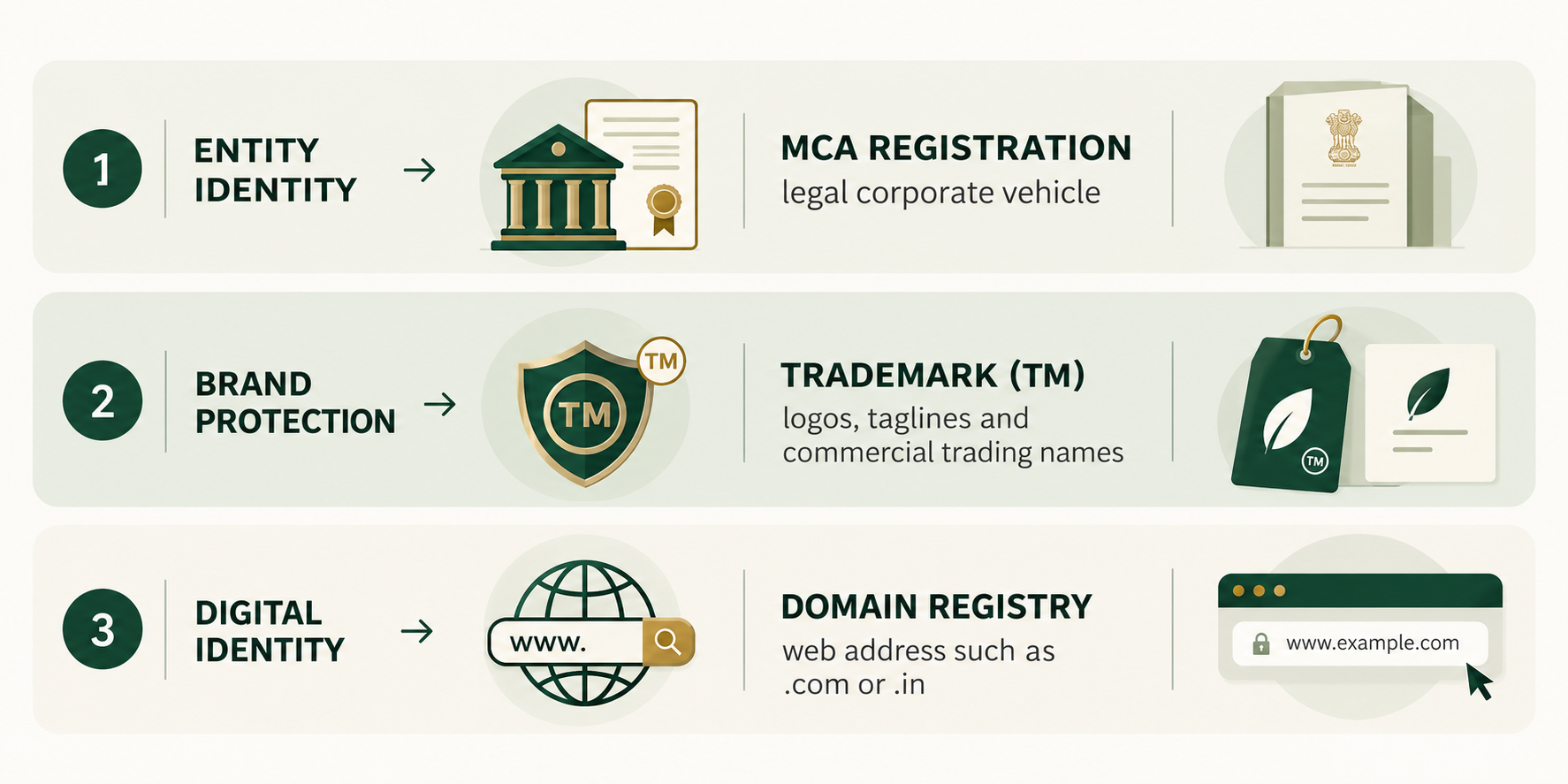
Breaking Down the Corporate Identity Stack
1. The Corporate Name (MCA Name)
- What it does: Registers your business vehicle with the Registrar of Companies (RoC). It allows you to sign legal vendor agreements, open corporate bank accounts, issue equity shares, and file corporate taxes.
- The Limit: It only prevents another founder from opening an incorporated company with the exact same name. It does not stop a competitor from opening a local partnership firm, selling products under your name, or running a retail shop using your identity.
2. The Trademark Registration (Brand Protection)
- What it does: Protects your commercial identity under the Intellectual Property India database. It gives you the exclusive right to use your brand name, logo, or catchphrase within your specific industry class.
- The Reality: If you get MCA approval for a corporate name but that name infringes on someone else's pre-existing registered trademark, the trademark owner can legally sue you for infringement. They can force you to change your corporate name entirely, destroying your early brand equity. A brand registration startup check is the only way to achieve true ownership.
3. The Digital Domain Name (Web Control)
- What it does: Controls your web location (such as yourbrand.com or yourbrand.in).
- The Limit: Domain registries are completely independent of the Indian government. Securing an available domain name does not give you any rights in the MCA database or the trademark registry.
Build a Secure, Future-Proof Brand with Entries Ignite
Conducting comprehensive corporate directory searches, checking cross-industry trademark classes, and handling complex MCA name applications can quickly derail your product launch. Entries Ignite eliminates the friction from your startup's naming and legal onboarding journey.
Our unified corporate operations suite handles your entire branding and entity layout securely. Leverage our integrated tools to run MCA name trademark cross-checks, upload your founder KYC details to your encrypted vault, collaborate directly with compliance experts, and complete your company incorporation alongside your protective trademark filings in one seamless digital workflow.
Start the entire incorporation checklist through Entries Ignite and track documents, tasks, and registrations in one place!